
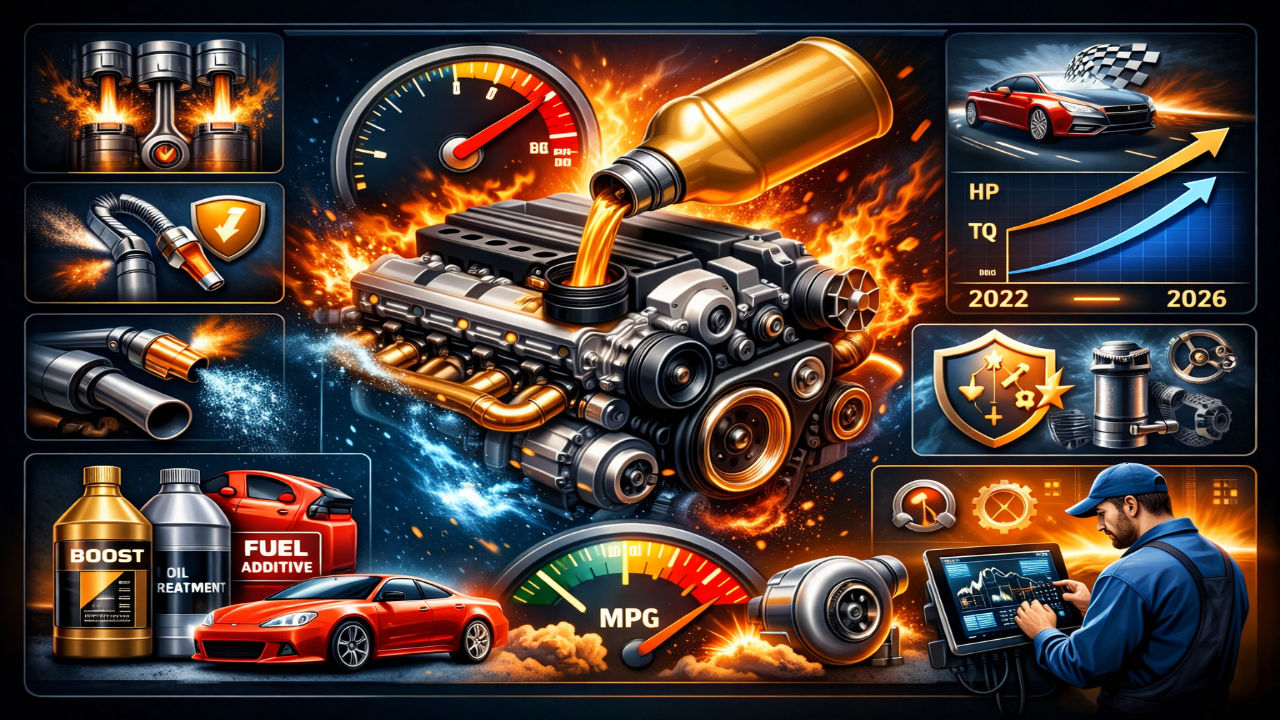
Most engine additives are marketing fluff. They promise big results and deliver nothing. A few, though, are backed by real science and real testing. Those are the ones worth your money.
In this guide, I've done the research so you don't have to. I went through competitor reviews, user data, dyno test results, and manufacturer specs to build this list. What you'll find here are the 8 best additives for engine performance and torque in 2026 - with honest explanations of what each one actually does.
Quick Answer: The best additive for engine performance and torque right now is Liqui Moly Cera Tec for most drivers. For aging or high-mileage engines, TriboTEX is the top nano-tech pick. For fuel system performance and better MPG, Lucas Oil Fuel Treatment is the one to grab.
Do Engine Additives Really Improve Torque and Performance?
Short answer? Yes - but only the right ones.
Torque is the pulling power your engine makes. It's what gets you off the line fast, tows heavy loads, and gives that satisfying surge when you put your foot down. And a lot of that torque gets eaten up inside your engine before it ever reaches the wheels.
Every time your pistons move, your bearings spin, and your valve train opens and closes - there's friction. That friction is wasted energy. Energy that could be torque, but isn't.
The best additives fight that friction. Some coat your metal parts with a protective film. Others clean out the gunk that's been choking your engine. And a few actually reverse physical wear damage.
The result? More usable torque. Smoother power delivery. Better fuel economy. And you don't need to spend thousands on a tuner or a new engine to feel the difference.
Best Engine Additives for Performance and Torque - At a Glance

Here's a quick comparison so you can find the right pick fast.
| Product | Best For | Key Technology | Rating |
|---|---|---|---|
| Liqui Moly Cera Tec | Overall performance + longevity | Ceramic micro-particles | ⭐ 4.7/5 |
| TriboTEX Nano Oil Additive | Wear reversal + torque recovery | Diamond-like nano coating | ⭐ 4.6/5 |
| Liqui Moly MoS2 Anti-Friction | Older + high-mileage engines | Molybdenum disulfide film | ⭐ 4.5/5 |
| Archoil AR9100 | Diesel + Ford Power Stroke | Nano friction modifier | ⭐ 4.5/5 |
| Lucas Oil Fuel Treatment | Fuel economy + power gains | Full fuel system cleaner | ⭐ 4.4/5 |
| BestLine Racing Diamond Nano | High-performance + racing | Diamond nano-coating | ⭐ 4.4/5 |
| Rislone XTREME LUBE | Sludge + noisy lifters | Multi-function treatment | ⭐ 4.3/5 |
| BG Advanced Formula MOA | Fleet + heavy-duty | Professional-grade MOA | ⭐ 4.3/5 |
How Engine Additives Actually Increase Torque and Performance
Before we jump to the products, let's talk about why these things work. Once you understand the basics, you'll be able to read any additive label and know immediately if it's worth buying.
The Friction-Torque Connection
Think of your engine as a chain of events. Fuel burns. Gas pushes the piston. The piston turns the crankshaft. The crankshaft turns the wheels. At every single step in that chain, friction is stealing energy.
Your piston rings scraping the cylinder walls. Your crank bearings spinning against metal. Your cam followers rubbing on the camshaft. Every one of those friction points bleeds torque before it reaches your tires. Reduce the friction - and you recover that lost torque. Simple as that.
4 Ways Additives Deliver Real Performance Gains
1. Friction Modifiers These are the workhorses of the additive world. They include MoS2 (molybdenum disulfide), ceramic particles, and nano-diamond coatings. They work by forming an ultra-thin, slippery film on metal surfaces. That film stops metal-on-metal contact and lets parts move more freely.
2. Engine Cleaners and Detergents Over time, sludge, varnish, and carbon deposits build up inside your engine. They restrict oil flow. They stick to piston rings and prevent proper sealing. Detergent-based additives dissolve all of that buildup, restoring full oil flow and compression.
3. Fuel System Additives These work on the other side of the equation - combustion. By cleaning injectors and combustion chambers, they help fuel burn more completely. Better combustion = more power per stroke = more torque.
4. Anti-Wear Compounds (ZDDP) This one is critical for older and classic engines. Modern motor oils have had their ZDDP content reduced to meet emissions rules. But flat-tappet camshafts in older muscle cars need that zinc compound for protection. Without it, cam lobes wear away fast.
What the Real-World Data Shows
- Dyno and wear-scar tests have documented friction reductions of up to 60% with advanced nano-lubricants
- Most drivers notice results after 300–1,000 miles as the additive films fully bond to metal surfaces
- Fuel economy improvements of 1–5 mpg have been reported across multiple independent tests
- TriboTEX's own dyno testing shows a 3% horsepower increase and up to a 5% fuel economy improvement
These aren't massive numbers - but they're real, measurable, and repeatable. And for a $20–$100 product, that's excellent value.
The 8 Best Additives for Engine Performance and Torque (2026)

#1 - Liqui Moly Cera Tec - Best Overall Additive for Engine Performance

What is it?
Liqui Moly is a German brand trusted by mechanics and enthusiasts worldwide. Cera Tec is their premium ceramic oil additive - and it's consistently ranked at the top of every serious comparison test.
How does it work?
It uses a blend of MoS2 and ceramic micro-particles suspended in oil. When you run your engine, those particles get pressed into the microscopic gaps and imperfections on metal surfaces. They form a hard ceramic barrier that prevents metal-to-metal contact under load.
The result is less friction, less heat, and less wear - every time the engine runs.
What kind of performance difference will you feel?
Most drivers report a noticeably smoother engine within the first few hundred miles. Noise drops. The throttle feels more responsive. And because friction is directly costing you fuel, MPG tends to go up too.
One impressive stat: this additive's protection lasts up to 50,000 km per treatment. That's two to three oil changes worth of ceramic protection from a single bottle.
It holds a 4.7-star rating from over 24,000 verified users - which is rare for any automotive product.
Best for: Modern petrol and diesel engines, European cars, anyone running full synthetic oil.
One important warning: Do NOT use this in engines with wet clutches (like some motorcycles). The friction-reducing properties will cause clutch slippage.
Pros:
- Excellent real-world reviews with measurable noise and performance improvements
- Long-lasting protection - value per km is hard to beat
- Compatible with all commercial motor oils
- Works in both gas and diesel engines
Cons:
- Premium price compared to basic oil additives
- Not suitable for wet clutch systems
- Takes some mileage before full fuel savings become visible
#2 - TriboTEX Nano Oil Additive - Best for Wear Reversal and Torque Recovery

What is it?
TriboTEX is one of the most scientifically credible products on this list. It was developed with funding from NASA, the U.S. Department of Energy, the National Science Foundation, and the U.S. Air Force. This isn't a garage-brewed additive - it came out of national labs.
How does it work?
The technology uses synthetic nano-flakes. When you add them to your engine oil, they flow with the oil to every friction surface. But here's the clever part: the flakes have a sticky side and a slick side. They attach sticky-side-down to worn metal surfaces, particle by particle, and build up a diamond-like carbon coating right where the damage is.
After about 500 miles of driving, those flakes have essentially filled in and repaired scratches and worn areas that would otherwise cause ongoing friction and power loss.
What kind of performance difference will you feel?
TriboTEX's own dyno tests show a 3% horsepower increase and up to 5% better fuel economy. Those numbers are verified on actual engines. The company has published before-and-after photographs of piston rings - after 120,000 miles of highway driving, the damaged surface is visibly restored by the coating.
For a high-mileage engine that's lost its sharpness over time, this is the closest thing to a rebuild in a bottle.
Best for: High-mileage engines (75,000+ miles), engines that feel sluggish or have lost torque over time, diesel trucks, any engine showing signs of wear.
Pros:
- Backed by serious government-funded research
- Physically reverses wear damage - not just a lubricant film
- Works across cars, trucks, motorcycles, and small engines
- Lasts through multiple oil changes
Cons:
- Premium price point - highest on this list
- Takes 500+ miles to reach full effectiveness
- Overkill for newer, low-mileage engines
#3 - Liqui Moly MoS2 Anti-Friction Treatment - Best for Older and High-Mileage Engines

What is it?
This is Liqui Moly's molybdenum disulfide (MoS2) formula - a classic friction reducer that's been trusted by mechanics for decades. MoS2 is a solid lubricant, meaning it forms a physical film rather than relying on chemical reactions. It works even when the oil film breaks down.
How does it work?
MoS2 particles are incredibly flat and slippery. When they get between metal surfaces, they act like billions of tiny ball bearings. The molecules slide over each other with almost no resistance, dramatically cutting the friction your engine produces during every rotation.
This is especially valuable at cold start - the most damaging phase of any engine's life - when oil hasn't fully circulated yet.
What kind of performance difference will you feel?
In tests, engines felt smoother within the first 100 miles of use. Lifter tick - that tapping noise from the top of your engine - fades noticeably after a short drive. Oil pressure stays stable. High-RPM operation becomes quieter and more controlled.
Best for: Classic cars, older gas and diesel engines, daily commuters with high-mileage vehicles, anyone dealing with valve train noise or rough idling.
Pros:
- Fast results - improvement within 100 miles
- Excellent cold-start protection
- Works with mineral and synthetic oils
- Great value for the price
Cons:
- The dark tint of MoS2 can slightly change your oil's appearance - that's normal
- Not a cleaner - won't remove existing heavy sludge
- Some newer engines respond better to ceramic alternatives
#4 - Archoil AR9100 - Best Additive for Diesel and Ford Power Stroke Engines
What is it?
If you drive a diesel - especially a Ford Power Stroke - you need to know about Archoil AR9100. It's a nano-friction modifier specifically engineered to solve the most frustrating problem Power Stroke owners face: injector stiction.
How does it work?
HEUI injection systems (used in the 6.0L and 7.3L Power Stroke) use engine oil to actuate the injectors. Over time, a sticky residue called "stiction" builds up on the injector components, causing cold-start misfires, rough idling, and sluggish throttle response. AR9100 penetrates those systems and dissolves that buildup while simultaneously coating bearing surfaces with a protective nano-film.
Beyond the Power Stroke fix, it's a capable all-around oil additive. It works in gearboxes, hydraulic systems, differentials, and power steering too.
What kind of performance difference will you feel?
Power Stroke owners consistently report 80–100% elimination of cold-start injector problems after a single treatment. The throttle response sharpens. The idle smooths out. And the engine runs noticeably quieter.
For diesel truck owners who've been dealing with rough cold starts for years, this product is often described as life-changing.
Best for: Ford 6.0L and 7.3L Power Stroke owners, heavy-duty diesel applications, any driver experiencing cold-start hesitation or rough idle.
Pros:
- Highly effective stiction fix - documented 80–100% success rate
- Versatile across multiple vehicle systems
- Immediate, noticeable improvements in most diesel engines
Cons:
- Higher price than basic additives
- May need periodic reapplication for sustained benefits
- 16oz bottle may not be enough for very large engines
#5 - Lucas Oil 10003 Fuel Treatment - Best Fuel Additive for Torque and MPG
What is it?
Lucas Oil is one of the most recognized names in automotive additives. Their 10003 Fuel Treatment is marketed as the world's #1 fuel additive - and the sales numbers and user reviews back that claim up.
This is a fuel additive, not an oil additive. That distinction matters. Where oil additives fight mechanical friction, fuel additives improve what happens in the combustion chamber.
How does it work?
Lucas Fuel Treatment cleans your fuel injectors, carburetor, and combustion chamber walls. It neutralizes sulfur and other contaminants in the fuel. And it improves the lubricity of the fuel itself, which reduces wear on fuel pumps and injector tips.
A cleaner combustion chamber means more complete fuel burn. More complete burn means more power from the same amount of fuel.
What kind of performance difference will you feel?
Users have documented MPG improvements from 30–31 mpg all the way up to 36 mpg after regular use. Under load - during towing, highway acceleration, and high-RPM driving - the pull feels stronger because the engine is extracting more energy from each stroke.
It also reduces exhaust smoke, which is a visible sign of incomplete combustion being corrected.
Best for: Daily drivers of any gas or diesel vehicle, tow trucks and haulers, anyone wanting better fuel economy alongside performance improvement.
Usage: Add 3–4 oz per 20 gallons every 3,000 miles.
Pros:
- Documented, measurable MPG gains
- Works in gas, diesel, and even marine engines
- Affordable and widely available
- Comprehensive fuel system cleaning
Cons:
- Requires regular use every 3,000 miles for sustained results
- Use carefully in older carbureted engines - don't overdose
- The bottle can drip if you cut the tip - unscrew the cap instead
#6 - BestLine Racing Diamond Nano-Lubricant - Best for High-Performance and Racing Engines
What is it?
BestLine's Diamond Nano-Lubricant is an extreme-condition additive built for engines that live under stress. It uses diamond nano-coating technology - the same concept behind industrial cutting tools - to create an almost frictionless surface inside your engine.
How does it work?
The diamond nano-particles form an ultralow-friction film on all metal surfaces. That film is rated to withstand temperatures up to 1,800°F (982°C) - far beyond what any conventional oil additive can handle. At the same time, it reduces friction by up to 60% compared to untreated engines.
It also extends oil life, because less friction means less heat, and heat is the number one killer of engine oil.
What kind of performance difference will you feel?
In high-performance applications - turbocharged engines, boosted builds, track cars, racing engines - the noise reduction and smoothness are immediately noticeable. At sustained high RPM, where conventional additives break down, the diamond film holds strong.
For daily drivers with performance vehicles, the result is a more responsive engine with better protection under hard acceleration.
Best for: Turbocharged and supercharged vehicles, performance builds, racing engines, high-mileage performance cars that still get driven hard.
Compatible with gasoline, diesel, hybrid, and racing fuel systems.
Pros:
- 60% friction reduction - among the highest documented on this list
- Extraordinary heat resistance for boosted applications
- Works across all engine types, including hybrid
- Extends oil change intervals
Cons:
- Overkill for normal daily driving on a stock engine
- Premium price
- Results are most dramatic in performance applications - average drivers may not notice as much
#7 - Rislone XTREME LUBE - Best for Engines with Sludge and Noisy Lifters
What is it?
Rislone XTREME LUBE is a multi-function engine treatment. Instead of focusing on a single problem, it tackles three at once: friction, sludge, and valve train noise. If you've got an engine that hasn't been well-maintained, this is the place to start.
How does it work?
The formula penetrates deeply into bearing surfaces and piston ring grooves. It dissolves the varnish and sludge that accumulates from years of heat cycles and skipped oil changes. Then it holds those dissolved deposits in suspension so they get filtered out or drained away at your next oil change.
At the same time, the friction-reducing chemistry goes to work on the valve train, quieting noisy lifters and improving how the rings seal against the cylinder walls.
What kind of performance difference will you feel?
The most immediate change is usually noise reduction. If your engine ticks or taps, that often clears up within a few hundred miles. With deposits removed and rings sealing better, compression improves, and so does the engine's overall responsiveness.
Best for: Neglected engines, vehicles that've had irregular oil changes, engines with ticking or rough idling, anyone who's bought a used car and isn't sure about its maintenance history.
Pros:
- Three-in-one treatment - friction, sludge, and noise in one bottle
- Works over a wide temperature range
- Great starting point for engines in unknown condition
Cons:
- Not as specialized as single-purpose additives
- Heavy sludge may need a dedicated engine flush before treatment
- May need repeated application for severely neglected engines
#8 - BG Advanced Formula MOA - Best Professional-Grade Additive
What is it?
BG Products is a brand you won't find at the auto parts store - it's sold through dealerships, service shops, and fleet maintenance programs. BG Advanced Formula MOA (Motor Oil Additive) is what the professionals reach for when they want serious, long-term engine protection.
How does it work?
MOA conditions and revitalizes the oil itself. It stabilizes viscosity under extreme heat and cold, conditions rubber seals to prevent leaks, and provides a heavy-duty anti-wear layer on critical engine surfaces. Dealerships often add this during oil changes for customers who drive under severe conditions - frequent towing, extreme temperatures, extended oil change intervals.
What kind of performance difference will you feel?
MOA isn't a dramatic "feel it on the first drive" product. It's a long-game protectant. Engines that use it consistently show less wear, better seal integrity, and more stable oil pressure over time. Fleet operators see fewer engine failures and longer service intervals.
Best for: Fleet vehicles, trucks used for towing or hauling, vehicles driven in extreme climates, drivers who extend their oil change intervals.
Pros:
- Professional-tier formulation used by dealerships
- Excellent seal conditioning and viscosity stability
- Trusted in heavy-duty and fleet applications
Cons:
- Harder to find than retail brands
- Less dramatic short-term performance feel than other picks
- Primarily a protection product, not a torque booster
How to Choose the Best Additive for Engine Performance and Torque

With eight products on this list, how do you pick the right one for your situation? Here's a simple framework.
Step 1 - Match the Additive to Your Engine Type
Gas vs. Diesel Not all additives work equally in both. Archoil AR9100 is purpose-built for diesel. Liqui Moly Cera Tec and Lucas Fuel Treatment work well in both. Always check compatibility before buying.
Turbocharged Engines Boosted engines run hotter and under higher pressure. They benefit most from additives with high heat tolerance - BestLine Diamond Nano-Lubricant and Liqui Moly Cera Tec are both excellent here.
Wet Clutch Warning If you ride a motorcycle or drive a vehicle where the clutch runs in the same oil as the engine, avoid friction modifiers like Cera Tec. The same chemistry that reduces engine friction can cause clutch slippage.
Step 2 - Match the Additive to Your Engine Condition
| Engine Condition | Best Additive Type |
|---|---|
| New engine (under 30k miles) | Liqui Moly Cera Tec for preventive protection |
| High-mileage (75k+ miles) | TriboTEX for wear reversal |
| Sludge or neglected engine | Rislone XTREME LUBE to clean first |
| Classic / flat-tappet engine | ZDDP-based additive - non-negotiable |
| Diesel truck with cold-start issues | Archoil AR9100 |
| Performance or boosted engine | BestLine Diamond Nano-Lubricant |
Step 3 - Oil Additive or Fuel Additive?
This is a question a lot of people get confused about. Here's the simple breakdown:
Oil additives fight mechanical friction inside the engine. They directly recover torque that was being lost to heat and resistance.
Fuel additives improve combustion. They help your engine extract more power from the fuel it burns.
Both do different jobs. The best approach? Use both strategically. An oil additive like Cera Tec plus a fuel treatment like Lucas Oil gives you improvements on two fronts at once.
Step 4 - Dosage and Timing
A few rules that apply to almost every additive on this list:
- Add to fresh oil at oil change time. The additive bonds best to clean metal surfaces with fresh oil as the carrier.
- Follow the dosage exactly. More is not better. Over-dosing can actually hurt oil flow and viscosity.
- Be patient. Most friction film additives need 300–1,000 miles to fully bond and show their best results.
Red Flags to Avoid
Not every additive is worth your money. Here's what to watch out for:
- Outrageous claims with no dyno data, independent tests, or user reviews to back them up
- PTFE (Teflon-based) additives - some manufacturers ban these outright because the particles can clog oil filters
- Products with no compatibility information - always verify it works with your oil type (synthetic, conventional, or blend)
Conclusion - Best Additive for Engine Performance and Torque
Engine additives work when you choose the right one for the right situation. There's no single magic bottle that fixes every engine - but there absolutely are products that deliver real, measurable improvements.
Here are the best picks summarized by use case:
| Use Case | Best Pick |
|---|---|
| Best Overall | Liqui Moly Cera Tec |
| Best Nano-Tech / Wear Reversal | TriboTEX Nano Oil Additive |
| Best for Diesel Trucks | Archoil AR9100 |
| Best Fuel Additive | Lucas Oil Fuel Treatment |
| Best for Racing / Boosted Engines | BestLine Diamond Nano-Lubricant |
| Best for High-Mileage Engines | Liqui Moly MoS2 Anti-Friction |
| Best for Sludge and Noisy Lifters | Rislone XTREME LUBE |
| Best Professional Grade | BG Advanced Formula MOA |
The golden rule: match the additive to your engine's condition - not to the prettiest label on the shelf.
An engine that's been well-maintained and runs fine will benefit most from a preventive treatment like Cera Tec. An aging, high-mileage engine showing signs of wear needs the heavy lifting that TriboTEX provides. A diesel truck with cold-start headaches needs Archoil.
Pick the right tool for the job, follow the dosage instructions, and give it a few hundred miles. You'll feel the difference.
Have questions about which additive is right for your specific vehicle? Drop them in the comments below.
Common FAQ's
For most drivers, Liqui Moly Cera Tec is the top pick. Its ceramic compound technology reduces friction directly, recovering torque and improving throttle response. For older or worn engines that have lost performance over time, TriboTEX delivers more dramatic results because it actually rebuilds worn surfaces rather than just lubricating them.
Yes - the right ones genuinely do. MoS2 and ceramic friction modifiers are scientifically documented to reduce metal-to-metal contact and lower friction coefficients. The results are most pronounced in high-mileage vehicles and engines that have existing wear or deposit buildup. In a brand-new, well-maintained engine, the improvement will be smaller but still measurable over time.
Basic MoS2 friction reducers like Liqui Moly MoS2 show noticeable results within 100–300 miles. Ceramic-coating additives like Cera Tec take a bit longer to reach full effectiveness. Nano-coating treatments like TriboTEX need around 500 miles for the nano-flakes to fully bond and build the protective carbon layer. Fuel additives like Lucas can show MPG improvements within one or two full tanks.
Yes, absolutely. They work on completely different systems. A fuel additive goes into your gas tank and works in the combustion and fuel injection system. An oil additive goes into your crankcase and works on the mechanical friction surfaces. Using both together gives you gains on two fronts simultaneously.
Absolutely - and possibly even more so than for gas engines. High-pressure diesel injection systems are sensitive to fuel quality and lubricity. Archoil AR9100 is a game-changer specifically for Ford Power Stroke engines. For general diesel trucks, Liqui Moly MoS2 and Lucas Fuel Treatment both deliver strong, measurable results in everyday towing and hauling conditions.

Gerry is a certified automotive expert and founder of AutomotiveAH.com, specializing in vehicle maintenance, diagnostics, and engine systems, delivering trusted, research – driven automotive guidance.